How Long Does Unclaimed Property Claim Take? 2026 Guide
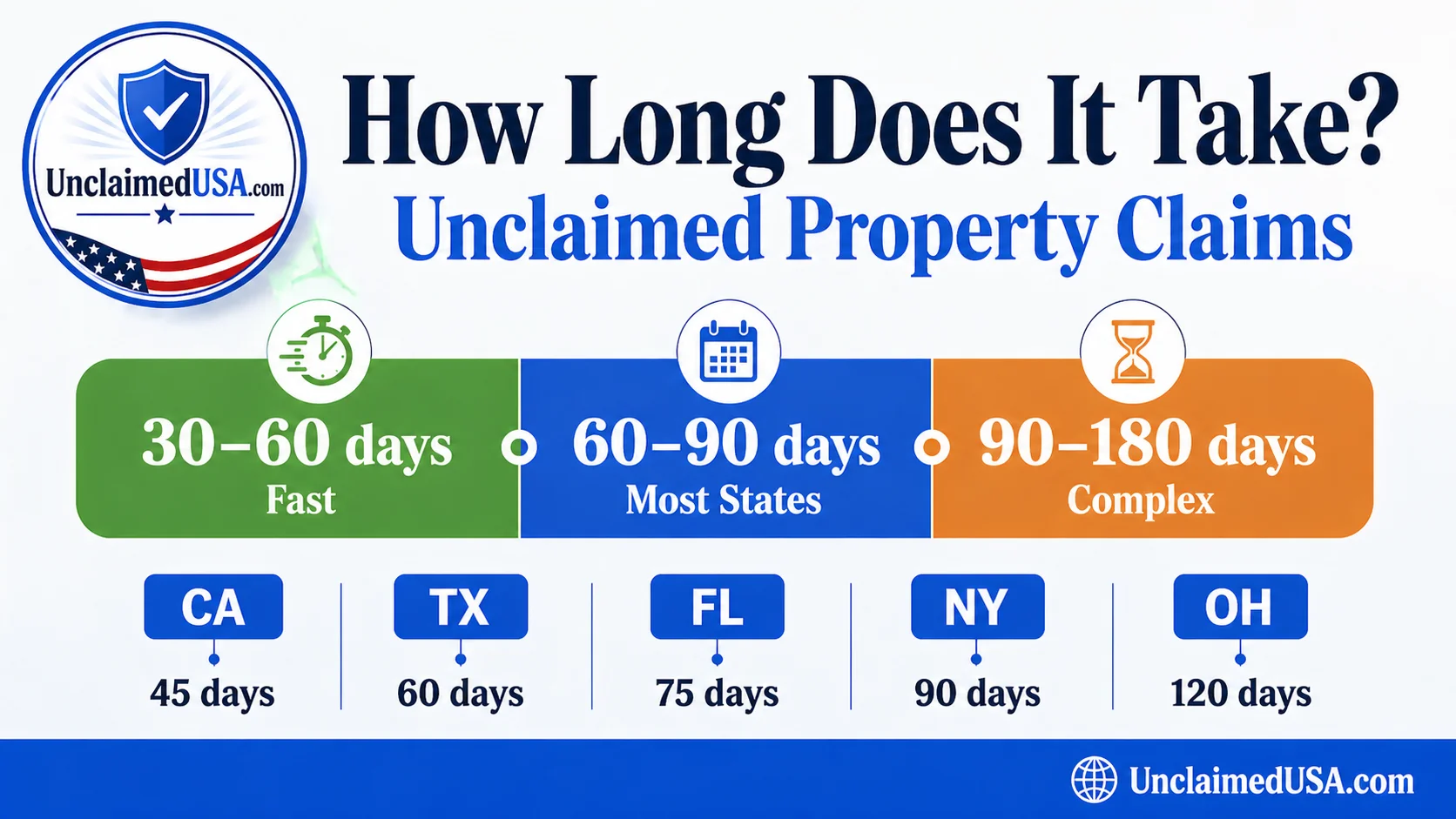
One of the most common questions people ask after filing an unclaimed property claim is this: how long does an unclaimed property claim take? The honest answer is that it depends on the state, the type of property you are claiming, and whether your documents were complete when you submitted. This guide gives you the most accurate, up-to-date processing time information available sourced directly from official state government portals so you know exactly what to expect before, during, and after you file.
Average Processing Time – What Most States Tell You
Some states complete the review process in less than 30 days. Most, however, take considerably longer. The national average for a straightforward individual claim with complete documentation is 60 to 90 days. This is the figure you will see referenced most often on official state websites, and it is a reasonable expectation for the majority of claimants.
However, that 60-to-90-day window assumes several things: that you submitted all required documents correctly the first time, that your claim is a simple one-owner cash claim, and that the state is not experiencing a surge in submissions. In practice, many claimants wait longer particularly in high-population states such as California, where the law allows up to 180 days for complex claims.
Once a claim has been processed successfully, you should receive a check for the unclaimed property amount if it is monetary, or the actual property if it is tangible.
Factors That Affect Processing Time
Not all claims move at the same pace. Several factors determine how quickly your specific claim is reviewed and approved:
Claim complexity – A simple cash claim with one owner and clean documentation is processed much faster than a claim involving multiple owners, securities, or an estate. Property owner claims that only involve cash may be processed in as little as 30 to 60 days. More complex claims such as those filed by heirs, those involving multiple owners, or those involving businesses are generally processed within the 180-day period.
Document completeness – This is the single biggest variable. An incomplete submission gets flagged, returned, or placed in a review queue. Every missing document extends your wait by weeks.
State claim volume – High-population states receive tens of thousands of claims every month. Due to the large volume of claims being processed, the law allows up to 180 days from the date the State Controller’s Office receives a complete claim package to review all documentation.
Property type – Cash is processed fastest. Securities require additional research into corporate history mergers, acquisitions, and stock splits before payment can be issued. Safe deposit box contents and tangible property involve physical verification.
Heir and estate claims – These are always slower because they require verification of legal relationships, death certificates, probate documents, and sometimes court orders.
System upgrades and transitions – States occasionally update their claim systems, which can temporarily affect timelines. California adopted a new unclaimed property management system in September 2025, which was designed to reduce processing times and improve efficiency going forward.
Seasonal peaks – January through March sees the highest claim volumes in most states, following end-of-year awareness campaigns. Filing in slower months summer or autumn can result in faster processing.
Processing Time by State – Top 20 States
The table below shows verified processing times for the 20 states that hold the most unclaimed property. All figures are sourced from official state government websites and represent the standard processing window for straightforward individual claims with complete documentation.
| State | Avg. Processing Time | Complex/Heir Claims | Official Search Site |
|---|---|---|---|
| California | 30–60 days (cash) | Up to 180 days | claimint.ca.gov |
| Texas | 60–90 days | Up to 90 days | claimittexas.gov |
| Florida | 60–90 days | Up to 120 days | myfloridacfo.com |
| New York | 60–90 days | Up to 120 days | ouf.osc.ny.gov |
| Pennsylvania | 60–90 days | Up to 120 days | patreasury.gov |
| Illinois | 60–90 days | Up to 120 days | icash.illinoistreasurer.gov |
| Ohio | 90–120 days | Up to 120 days | unclaimedfunds.ohio.gov |
| Georgia | 60–90 days | Up to 90 days | etax.dor.ga.gov |
| Michigan | 60–90 days | Up to 120 days | michigan.gov/unclaimedproperty |
| North Carolina | 90 days | Up to 120 days | nccash.gov |
| New Jersey | 60–90 days | Up to 120 days | unclaimedproperty.nj.gov |
| Virginia | 60–90 days | Up to 90 days | virginiamoneysearch.gov |
| Washington | 60–90 days | Up to 90 days | whatsmineisyours.com |
| Arizona | 60–90 days | Up to 90 days | azunclaimed.gov |
| Massachusetts | 60–90 days | Up to 90 days | findmassmoney.com |
| Tennessee | 60–90 days | Up to 90 days | treasury.tn.gov |
| Indiana | 60–90 days | Up to 90 days | indianaunclaimed.gov |
| Maryland | 60–90 days | Up to 120 days | marylandtaxes.gov |
| Missouri | 60–90 days | Up to 90 days | treasurer.mo.gov |
| Wisconsin | 60–90 days | Up to 90 days | statetreasury.wisconsin.gov |
Note: All times are from the date a complete claim package is received. Incomplete submissions restart the clock. Times shown are for standard individual cash claims. Estate, security, and business claims take longer.
What Happens During the Review Period
Understanding what the state is actually doing during those 60 to 180 days helps set realistic expectations and reduces anxiety while you wait.
Week 1–2: Receipt and logging – Your claim is received, logged into the state’s system, and assigned a claim number. You should receive a confirmation email or letter with that number. If you do not receive confirmation within two weeks, contact the state directly.
Week 2–6: Document review – A claims examiner verifies your identity documents, checks that your name and address match the property record on file, and confirms that the property type matches the documentation provided.
Week 4–8: Ownership verification – The examiner verifies that you are the legal owner. For simple claims, this may mean nothing more than confirming your Social Security Number matches. For more complex claims, this stage takes longer.
Week 6–10: Approval or follow-up – If everything checks out, your claim is approved. If there is a discrepancy, the state will contact you to request additional documentation. Responding quickly at this stage is critical delays in response extend your total wait significantly.
Week 8–16: Payment processing – Approved claims are queued for payment. Cash payments are issued by check mailed to your address on file. Once your claim has been processed successfully, you should receive a check for the unclaimed property amount. Security claims may take additional time as the state researches corporate history before issuing payment.
How to Check Your Claim Status
Every state provides a way to check the status of a submitted claim. Do not wait until your expected window has passed check early and regularly.
Online status check – Most states have a dedicated status portal. You will need your claim number, which is typically included in your confirmation email. Key portals include:
- California: claimint.ca.gov
- Ohio: unclaimedfunds.ohio.gov/app/claim-status-search
- North Carolina: nccash.gov – click “Claim Status”
- Pennsylvania: patreasury.gov/unclaimed-property
By phone – Every state’s unclaimed property division has a public phone line. Persons who wish to check their claim status may use the claim number to look up the claim status online. Alternatively, call the agency helpline.
Key phone numbers:
- California: (800) 992-4647
- Ohio: (614) 728-9769
- Pennsylvania: (800) 222-2046
- North Carolina: (919) 814-4200
By email – Many states accept status inquiries by email. Ohio’s claims team can be reached at claims@com.ohio.gov. California’s team is available through the contact form at sco.ca.gov.
Allow at least 30 days after filing before checking status. Most states need this time simply to log and enter your claim into their system.
What to Do If Your Claim Is Taking Too Long
If your claim has passed the expected window with no update, take these steps:
- Check your spam folder – State communications often end up filtered. Search for emails from your state’s treasury or comptroller office going back to when you filed.
- Log into the status portal – Use your claim number to check the current status. A status of “pending” or “under review” is normal. A status of “additional documentation required” means the state has sent you a request you may have missed.
- Call the state directly – Phone lines are open during business hours. Have your claim number ready. Ask specifically whether your claim is complete or whether additional documents are needed.
- Resubmit missing documents – If the state flagged your claim for incomplete documentation, gather what is needed and resubmit as quickly as possible. The processing clock effectively resets when new documents are received.
- Request a hardship review – Most states offer an expedited review process for genuine financial hardship situations. Ask the claims representative about this when you call.
- File a written inquiry – If phone and email contact is not producing results, send a written inquiry by certified mail referencing your claim number, the date you filed, and the property account number.
Expedited Processing – Is It Possible?
Given these differences, it is essential to consult the specific state unclaimed property program for precise timelines and claim procedures. However, most states do offer some form of priority review for documented hardship cases.
When hardship expediting may apply:
- Serious medical emergency requiring immediate funds
- Imminent foreclosure or eviction
- Terminal illness of the claimant
To request expedited review, contact the state’s unclaimed property division directly by phone, explain the situation, and ask about their hardship process. Some states require written documentation of the hardship medical bills, court notices, or letters from healthcare providers.
There is no guarantee of faster processing even in hardship cases, and approval is at the discretion of the reviewing agency. However, it is always worth asking.
What expedited processing is not: paying a third-party locator service more money does not speed up state processing. The state reviews claims in the order they are received, regardless of whether an individual filed directly or used a locator service.
Frequently Asked Questions
What is the fastest an unclaimed property claim can be processed?
Some states complete this process in less than 30 days. For a simple cash claim with a single owner, complete documentation, and a state with lower claim volumes, it is possible to receive payment within 30 days of submitting a complete package. This is the best-case scenario, not the norm.
Does the type of property affect how long it takes?
Yes – significantly. Cash claims are always processed fastest. Security claims involving stocks or bonds require research into corporate activity during the period the state held them, which can add weeks or months to the timeline. While most security claims are paid within 120 days, some security claims that require extensive research may take longer to process.
Does filing online vs. by mail make a difference?
Yes. Online filing is faster because documents arrive instantly and are entered into the system immediately. Mail submissions require physical receipt, opening, scanning, and manual entry – typically adding two to three weeks before the review even begins. Most states strongly recommend online filing for this reason.
Will I receive interest on my unclaimed property while the state held it?
It depends on the state. Interest accrues on unclaimed funds reported to the Ohio Department of Commerce, and both principal and interest are paid out to claimants on approved claims. California, by contrast, does not pay interest. Check your specific state’s policy when you file.
Is there a deadline to file my claim?
There is no time limit to file a claim and no fee for this service. This applies in virtually every US state. Property held for 5, 10, or even 20 years can still be claimed. Do not let the length of time that has passed discourage you from filing.
Conclusion
Understanding how long an unclaimed property claim takes removes the uncertainty from the process. For most Americans filing a standard individual cash claim, the realistic expectation is 60 to 90 days from the date a complete package is submitted. Complex claims those involving estates, securities, or multiple owners should expect 90 to 180 days.
The single most important thing you can do to speed up your claim is to submit all required documents correctly the first time. The second most important thing is to check your status regularly and respond immediately if the state contacts you for more information.