Unclaimed Property Safe Deposit Box – What Happens Inside
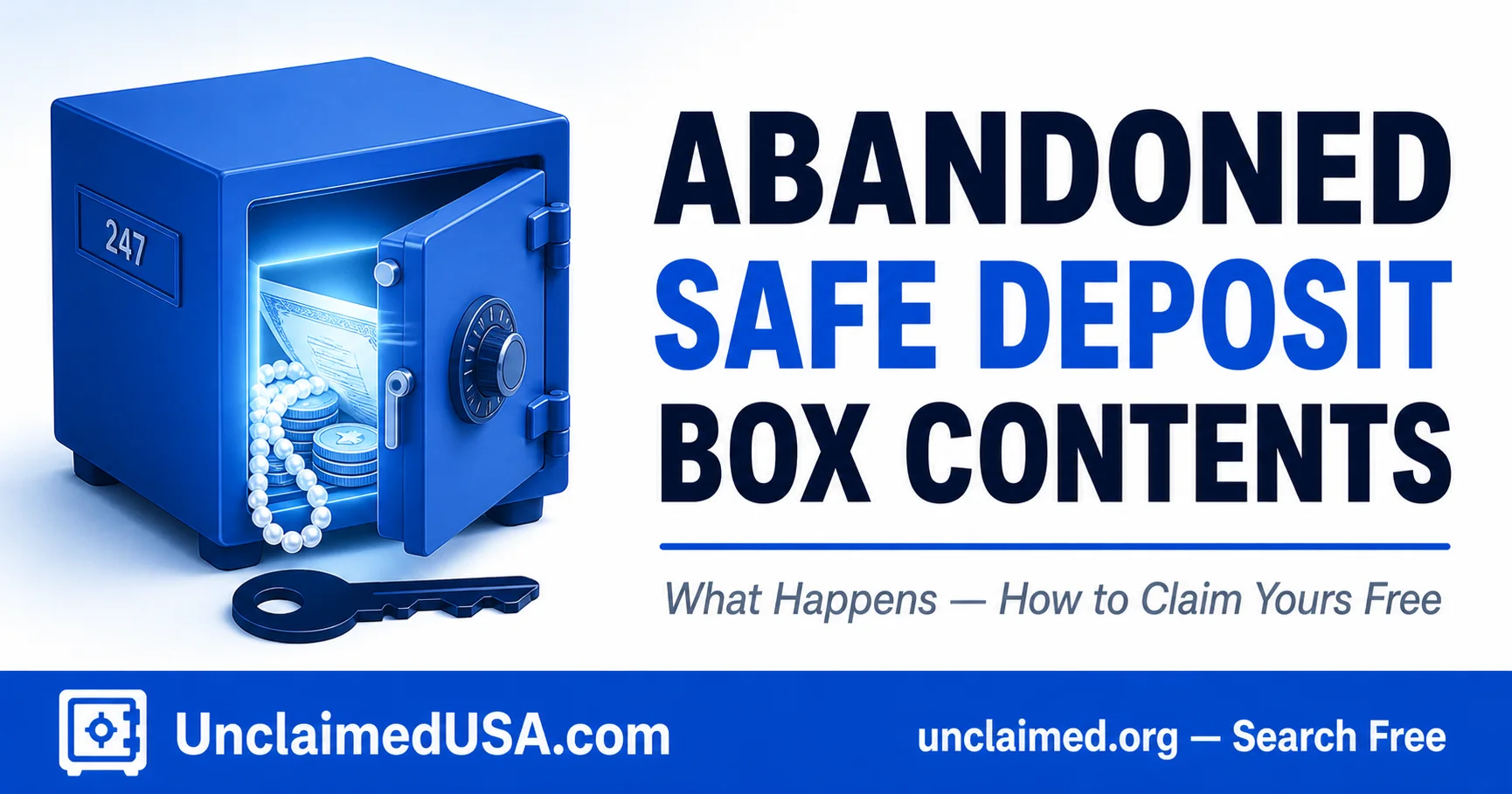
Every year, thousands of safe deposit boxes across the United States are drilled open by banks and their contents transferred to state governments as unclaimed property. Inside these boxes often untouched for years or even decades states have found gold coins, diamond rings, military medals, rare collectibles, cash, stock certificates, and irreplaceable personal documents. The unclaimed property safe deposit box system is one of the least-known but most fascinating parts of the US unclaimed property program. If you have ever lost track of a safe deposit box rental, or believe a deceased relative may have had one, this guide explains exactly what happens to abandoned box contents and how to find and claim them completely free.
What Happens When a Safe Deposit Box Is Abandoned
A safe deposit box becomes abandoned when the renter stops paying the annual rental fee and the bank cannot reach them. The process that follows is governed by state unclaimed property law and typically unfolds in stages.
Stage 1 – Missed rental payments. When a box owner stops paying the rental fee, the bank first attempts to contact the renter by mail, phone, and email using the contact information on file. Most banks send multiple notices over an extended period.
Stage 2 – Drilling the box. When contact attempts fail and the rental fee goes unpaid for the required dormancy period, the bank is legally authorized to drill open the box and inventory its contents. The dormancy period for safe deposit boxes varies by state:
- Florida: Box rent unpaid for three consecutive years; contents then held by the Division of Unclaimed Property for a minimum of two additional years before any auction
- Texas: Contents drilled and remitted after lease expiration of five years
- Pennsylvania: Dormancy begins on the date the rental period expired
- Arizona: Annual auctions held for items held after the required retention period
Stage 3 – Inventory and transfer to state. After drilling, the bank creates a detailed inventory of the contents. Items with monetary or collectible value are transferred to the state’s unclaimed property division. Documents without commercial value such as personal letters and photographs may or may not be accepted depending on the state. Pennsylvania, for example, explicitly does not accept miscellaneous papers or documents without monetary value such as birth and death certificates, deeds, or letters.
Stage 4 – State notification efforts. Once the state receives the contents, it uses multiple methods to locate the owner: sending letters to the last known address, advertising in newspapers, posting on the official unclaimed property website, and in some cases conducting database matching. The state holds the items in a secure vault while these notification efforts continue.
How Contents Are Transferred to the State as Unclaimed Property
The transfer process is governed by each state’s unclaimed property act. The bank acts as the “holder” and is required by law to report and remit abandoned safe deposit box contents to the state in the same annual reporting cycle used for financial assets.
Common items transferred to state vaults include:
- Gold and silver coins, bars, and bullion
- Jewelry including rings, necklaces, bracelets, and watches
- Stock certificates and bearer bonds
- Cash in various currencies
- Military medals, dog tags, Purple Hearts, and bronze stars
- Collectible items including baseball cards, stamps, and rare books
- Antiques and heirloom items
- Firearms (handled under special protocols with firearms licensing requirements)
What most people do not realize is that the state’s obligation to the original owner does not end when the physical items leave the vault. Under virtually every state’s unclaimed property law, the cash proceeds from any auctioned items are held in perpetuity for the rightful owner. Even if the items themselves are gone, the money they generated belongs to you.
Pennsylvania’s official policy is explicit: physical items from safe deposit boxes are held for three years, after which they may be liquidated but the cash proceeds from the sale are held in perpetuity by the state to be claimed by the rightful owner. Arizona’s official press releases confirm the same: “Proceeds from items sold at auction are transferred to a custodial account where the funds will remain for the rightful owners to claim.” Texas similarly maintains military medals indefinitely and never auctions them.
How to Find Out If Safe Deposit Box Contents Are Now State Property
If you believe a safe deposit box you or a deceased relative rented may have been drilled and transferred to a state, here is how to search:
- Search your state’s official unclaimed property database go to your state’s portal (found through unclaimed.org) and search the box renter’s name. Safe deposit box contents appear in the database listed under the renter’s name, often with the bank or financial institution shown as the holder. The property type will typically be listed as “Safe Deposit Box” or “Tangible Property.”
- Use missingmoney.com the NAUPA-endorsed national multi-state search at missingmoney.com covers most states simultaneously and includes safe deposit box listings.
- Contact the bank directly if you know which bank held the safe deposit box, contact the bank’s customer service or estate department. Ask whether the box was drilled, when it was drilled, and to which state the contents were remitted. Get the report date if possible, as this helps locate the exact listing in the state database.
- Search in the state where the box was located safe deposit box contents are remitted to the state where the bank branch is located, not necessarily where the renter currently lives. If the box was at a bank in Florida, search Florida’s database at fltreasurehunt.gov.
- Check state auction records if items have already been auctioned, some states maintain records of past auctions including lot descriptions. The cash proceeds from these auctions remain in the state’s unclaimed property system and are searchable by the former owner’s name.
How to Claim Abandoned Safe Deposit Box Contents
Once you locate an entry for safe deposit box contents in a state database, the claim process follows the standard unclaimed property claim procedure. Here is the step-by-step process:
- Click on the matching property listing in the state’s official database
- Begin the online claim process most states now have fully online claim portals
- Select your relationship to the property if you are the original renter, choose Owner; if claiming for a deceased relative, choose Heir or Estate Representative
- Complete the claim form provide your full legal name, current address, date of birth, and Social Security Number
- Upload supporting documentation see the full document list in Section 7 below
- Submit your claim electronically through the state portal
- Wait for your claim to be assigned to a specialist safe deposit box claims may take longer than standard cash claims because physical property verification requires additional steps
- Respond promptly if the state requests additional documentation this is common for tangible property claims
- Receive your payment or property if physical items still exist in the vault, they may be returned to you directly; if items were auctioned, you receive the cash proceeds
For states that hold physical items prior to auction, you may request the return of the actual items rather than cash contact the state’s unclaimed property division directly to ask about this option before filing your claim.
What If the Contents Were Auctioned – Can You Still Claim the Value?
Yes and this is one of the most important facts to understand about abandoned safe deposit box contents.
Even after a state auctions off physical items from a safe deposit box, the cash proceeds from that auction are held for the rightful owner indefinitely. This is a consistent policy across virtually all state unclaimed property programs and is confirmed by official sources in multiple states:
- Arizona (official press release, April 2025): “Proceeds from items sold from the auction are transferred to a custodial account where the funds will remain for the rightful owners to claim.”
- Pennsylvania Treasury (official policy page): “Tangible property is held for three years, after which time it may be liquidated and the cash proceeds from the sale held in perpetuity by the state to be claimed by the rightful owner.”
- Florida (official auction FAQ): Contents are held by the Division of Unclaimed Property and proceeds remain available for the rightful owner.
- Texas: “Most items are held for one year before being sold on public auction sites like GovDeals. The cash raised from the sale is credited to the owner’s account in perpetuity.”
The one important exception noted by multiple states: military medals, medals of valor, and similar honors are never auctioned. Texas holds military awards indefinitely and explicitly states they are “preserved indefinitely for the veteran or their family.” Colorado also specifically holds military medals and works to return them to veterans’ families through dedicated outreach.
If the physical items are gone, search the state unclaimed property database for a cash listing under the former renter’s name. The amount may reflect the auction proceeds held on their behalf.
How to Prevent Your Safe Deposit Box From Becoming Unclaimed Property
Protecting your safe deposit box from abandonment is straightforward with a few simple steps:
- Pay your rental fee every year without fail set up automatic payment through your bank if possible; most banks now offer this option
- Keep your contact information current with the bank update your address, phone number, and email address every time they change; the bank uses this information to reach you when you miss a payment
- Tell a trusted family member the box exists include the bank name, branch location, box number, and key location in your estate documents or with your will
- Add a co-renter or authorized person many banks allow you to add a co-renter or deputy access holder who can access the box if you become incapacitated; this prevents abandonment in situations where the primary renter can no longer manage their affairs
- Include the safe deposit box in your estate documents list the box, its contents, and the bank in your will or trust documents so your executor or heirs can access it promptly after your death
- Consolidate if necessary if you have multiple safe deposit boxes at different institutions, consolidate them into one to simplify management and reduce the chance of forgetting a rental payment
- Consider whether the contents still need physical storage many items once kept in safe deposit boxes can now be digitized (documents, photos, certificates) or may be more cost-effectively stored at home in a fireproof safe
Documents Needed to Claim Safe Deposit Box Contents
The documentation requirements for safe deposit box claims are similar to other unclaimed property claims but may include additional steps for physical property verification.
If you are the original box renter:
- A current, valid government-issued photo ID (driver’s license, state ID, or passport)
- Your Social Security Number
- Documentation connecting you to the box the original safe deposit box rental agreement, receipts for rental payments, a key to the box (if you still have it), or any correspondence from the bank about the box
- Proof of your address at the time the box was rented old utility bills, tax documents, or bank statements
If you are claiming as a heir or estate representative:
- A certified copy of the death certificate
- Letters Testamentary (if the deceased had a will) or Letters of Administration (if there was no will) issued by the relevant probate court
- Your own valid government-issued photo ID
- Your own Social Security Number
- Proof of your relationship to the deceased (birth certificate or marriage certificate as applicable)
- Documentation connecting the deceased to the safe deposit box rental any records showing their name and the bank
Additional notes for tangible property claims:
- Some states may ask for a detailed description of what you believe was in the box, to assist in matching physical inventory records
- If the state’s records show a specific lot or inventory number for the items, include this information in your claim
Frequently Asked Questions
How long does a bank wait before drilling a safe deposit box?
The waiting period varies by state, but most states require between three and five years of unpaid rent and failed contact attempts before a bank can drill a box. Florida requires box rent to be unpaid for three consecutive years. Texas requires five years after lease expiration. Pennsylvania measures dormancy from the date the rental period expired. After drilling, the bank typically inventories the contents and reports them to the state, which then holds items for an additional retention period before any auction.
What items does the state not accept from safe deposit boxes?
State policies on non-accepted items vary, but Pennsylvania’s official policy is representative: miscellaneous papers and documents without monetary value including personal letters, photographs, birth certificates, death certificates, deeds, and similar papers are generally not accepted by the Bureau of Unclaimed Property. Items with recognized commercial or collectible value, such as coins, jewelry, and financial instruments, are accepted and held for the rightful owner.
Can I attend the state auction for safe deposit box contents and buy items?
Yes – state auctions of abandoned safe deposit box contents are open to the public in most states. Arizona holds annual public auctions through Sierra Auction Management. Florida holds auctions through Fisher Auction Company. North Carolina’s NCCash holds regular auctions with online bidding. However, buying an item at auction does not extinguish the original owner’s right to the cash proceeds even after you purchase an item, the previous owner retains the right to claim the equivalent cash value from the state.
What happens to firearms found in abandoned safe deposit boxes?
Firearms found in abandoned safe deposit boxes require special handling under federal and state law. Louisiana’s statute, for example, requires firearms to be sold through a public or private auction only through an auctioneer who holds a federal firearms license. States typically coordinate with licensed dealers or law enforcement for firearms disposal. If you believe a firearm belonging to a deceased relative was in an abandoned safe deposit box, contact your state’s unclaimed property division directly for guidance the process differs from standard tangible property claims.
If the state has already auctioned the contents of a relative’s safe deposit box, can I still get the money?
Yes – the cash proceeds from state auctions of safe deposit box contents are held indefinitely for the rightful owner or their heirs. Search your state’s unclaimed property database for the former renter’s name the auction proceeds should appear as a cash listing. File a standard heir claim with the appropriate estate documentation, and the state will pay you the cash proceeds generated from the sale of those items. There is no deadline to file this type of claim in most states.
Conclusion
Abandoned safe deposit box contents represent one of the most tangible and often emotionally significant categories of unclaimed property. Gold coins, family jewelry, military medals, and irreplaceable documents sit in state vaults every year while their rightful owners or heirs remain unaware. The good news is that states take these custodial responsibilities seriously holding physical items for years before any auction, and holding the cash proceeds from those auctions in perpetuity.
If you believe a safe deposit box you or a family member rented has been abandoned, search today. The process is free, the state databases are updated regularly, and your right to claim what is inside or the cash proceeds if it has already been auctioned never expires.
Start your free search right now:
- All state unclaimed property portals: unclaimed.org
- Multi-state search including safe deposit box listings: missingmoney.com
- Your state’s official portal: search unclaimed.org for your state’s direct link